
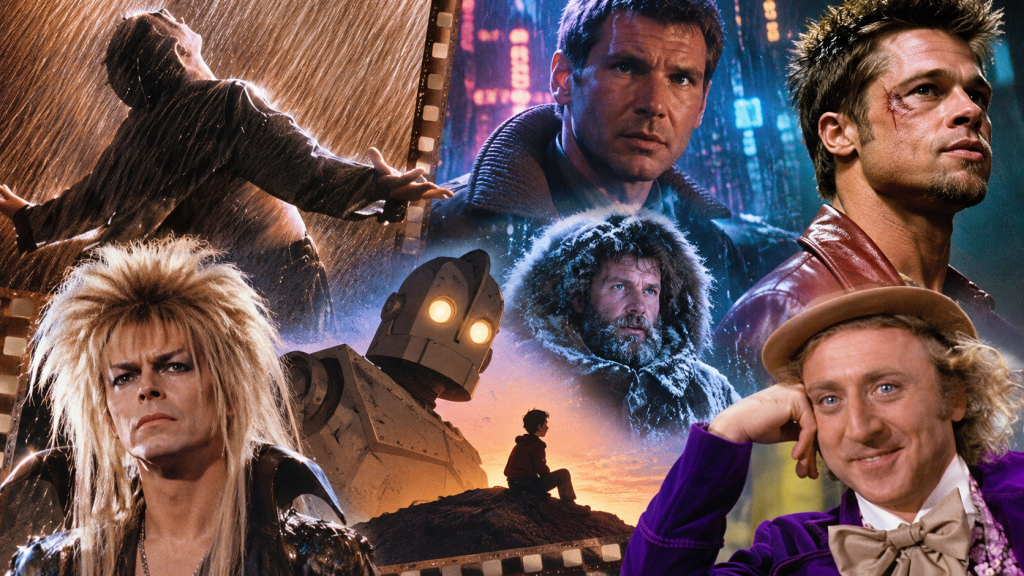
Imagine being a Hollywood executive in 1994 and looking at the disappointing ticket sales for The Shawshank Redemption. You’d probably write it off, move on to the next project and never give it much thought again.
Today, it’s widely considered one of the greatest movies ever made.
Hollywood has a long history of getting it wrong. Sometimes the marketing misses the mark. Sometimes a movie opens against a much bigger blockbuster. And sometimes audiences simply aren’t ready for what they’re watching.
Whatever the reason, these ten movies prove that a disappointing opening weekend doesn’t necessarily mean you’ve made a bad movie.
1. The Shawshank Redemption (1994)
It’s almost ridiculous to think that this movie struggled to find an audience.
The prison drama starring Tim Robbins and Morgan Freeman earned roughly $16 million during its initial theatrical run against a reported $25 million production budget.
It didn’t help that 1994 was an exceptionally competitive year for movies, with Forrest Gump and Pulp Fiction commanding audiences’ attention.
Video rentals, television broadcasts and word of mouth eventually gave Shawshank the audience it deserved. Today, it’s difficult to have a conversation about the greatest movies ever made without someone bringing it up.
2. The Thing (1982)
John Carpenter probably couldn’t have picked a worse summer to release a movie about a horrifying alien creature.
Just two weeks earlier, Steven Spielberg had introduced audiences to a friendly little extraterrestrial named E.T. People were falling in love with aliens, not particularly interested in watching them tear people apart.
Critics weren’t especially kind to Carpenter’s film either.
Decades later, its practical effects remain remarkably impressive, and its atmosphere of paranoia is something many modern horror movies struggle to replicate.
3. The Iron Giant (1999)
A giant robot, a lonely kid and a story about choosing who you want to be. It sounds like a recipe for an animated blockbuster.
Instead, The Iron Giant earned approximately $23 million domestically against a reported production budget of around $50 million.
Poor marketing is frequently blamed for its disappointing performance. Many people simply didn’t know much about the movie when it arrived in theaters.
Fortunately, home video and television gave it another chance. It has since become one of the most beloved animated films of its generation.
And yes, that ending still gets people.
4. Office Space (1999)
Apparently, Hollywood underestimated how much people hated their jobs.
Mike Judge’s comedy about miserable office workers barely made a dent at the box office, earning around $12 million against a $10 million production budget.
Once theater shares and marketing expenses are considered, those aren’t particularly good numbers.
But anyone who had ever endured a pointless meeting, a malfunctioning printer or an annoying manager immediately understood the movie.
Its popularity exploded through home video and cable television. The red stapler, TPS reports and printer destruction scene became permanent fixtures of workplace humor.
Somehow, the movie feels just as relevant today.
5. Blade Runner (1982)
Harrison Ford was already a huge star thanks to Star Wars and Raiders of the Lost Ark. Yet Ridley Scott’s dark, philosophical science-fiction film struggled commercially when it arrived in theaters.
Audiences expecting another fast-paced Harrison Ford adventure instead got a slow-burning story about artificial life, identity and mortality.
It wasn’t quite what everyone wanted in 1982.
Today, its rain-soaked streets, neon signs and futuristic cityscapes can be seen influencing everything from video games to music videos and countless science-fiction movies.
An entire visual aesthetic owes something to a film that Hollywood initially considered a disappointment.
6. Fight Club (1999)
A movie starring Brad Pitt and Edward Norton should have been an easy sell.
But how exactly do you market a dark satire about consumerism, masculinity and a secret organization built around men punching each other?
Fight Club earned approximately $37 million domestically against a reported $63 million production budget. International earnings helped, but its theatrical performance was disappointing.
Then came DVD.
The film found an audience that watched it repeatedly, debated its meaning and discovered details they had missed the first time around.
It eventually became one of the most recognizable and discussed movies of the late 1990s.
7. It’s a Wonderful Life (1946)
One of America’s most beloved Christmas movies was originally a financial disappointment.
Despite receiving five Academy Award nominations, Frank Capra’s film failed to recover its costs during its original release.
Its transformation into a holiday tradition happened decades later. When its original copyright registration was not renewed, television stations began broadcasting it extensively.
Generations of families grew up watching George Bailey discover the value of his own life.
It’s strange to imagine Christmas television without a movie that audiences largely overlooked when it was new.
8. Labyrinth (1986)
David Bowie as the Goblin King. Jim Henson’s puppets. A bizarre fantasy world filled with strange creatures and impossible architecture.
There really wasn’t anything quite like Labyrinth.
Unfortunately, that originality didn’t translate into strong American ticket sales.
The film found its following through home video, television and the enthusiasm of fans who grew up watching it.
Its costumes, songs and wonderfully strange characters have kept it alive across generations.
It turns out that being a little too weird for mainstream audiences isn’t necessarily a bad thing.
9. The Rocky Horror Picture Show (1975)
Most movies are considered failures when audiences stop showing up.
This one became successful because people started showing up over and over again.
Its initial release was disappointing, but midnight screenings gave the film an entirely new life.
Fans began dressing as characters, shouting responses at the screen and bringing props to participate in the movie. Watching it became a social event rather than simply a trip to the theater.
Decades later, that tradition continues.
Few films have managed to turn their audiences into part of the entertainment quite like Rocky Horror.
10. Willy Wonka & the Chocolate Factory (1971)
Gene Wilder’s performance as Willy Wonka is practically inseparable from popular culture.
Yet the original film wasn’t a major theatrical success.
Television broadcasts and home video helped introduce it to generations of children who became fascinated by its strange candy factory, memorable songs and occasionally unsettling sense of humor.
Wilder’s performance remains particularly memorable because his Wonka is never entirely predictable. You can’t always tell whether he’s joking, teaching someone a lesson or enjoying the chaos unfolding around him.
What was once a commercial disappointment became a childhood favorite.
Maybe Hollywood Should Give Movies More Time
These days, a movie can be declared a failure before its opening weekend is even over.
But some movies need time. They need people talking about them, recommending them to friends and discovering them years after their original release.
A massive box office doesn’t guarantee that anyone will remember a movie twenty years from now. And a nearly empty theater doesn’t mean a filmmaker hasn’t created something special.
Sometimes the audience just hasn’t found it yet.
What’s your favorite movie that didn’t get the attention it deserved when it first came out?